Urban curiosities – industrial past – exhibition
Along Boulevard de Strasbourg and in the heart of the Danton district, pre-war Le Havre comes into view. Between the wide avenues designed by Auguste Perret and the hillside, the small streets of the “Old Centre” unfold—once an industrial suburb where warehouses, breweries, and refineries stood alongside public buildings.
This route links the city center and the train station. Beyond the station, a short detour leads you to the Eure district, a former port area now home to ambitious contemporary architecture.
Step 1 : Coupes
Echoing the sculpture of Saint Joseph’s Church’s spire, the station’s glass windows are tinted in colours inspired by those of the church itself. Contrasting with the cool tones of the concrete, they are a breath of new life for the area.
-Mickael-Liblin-(15).jpg)
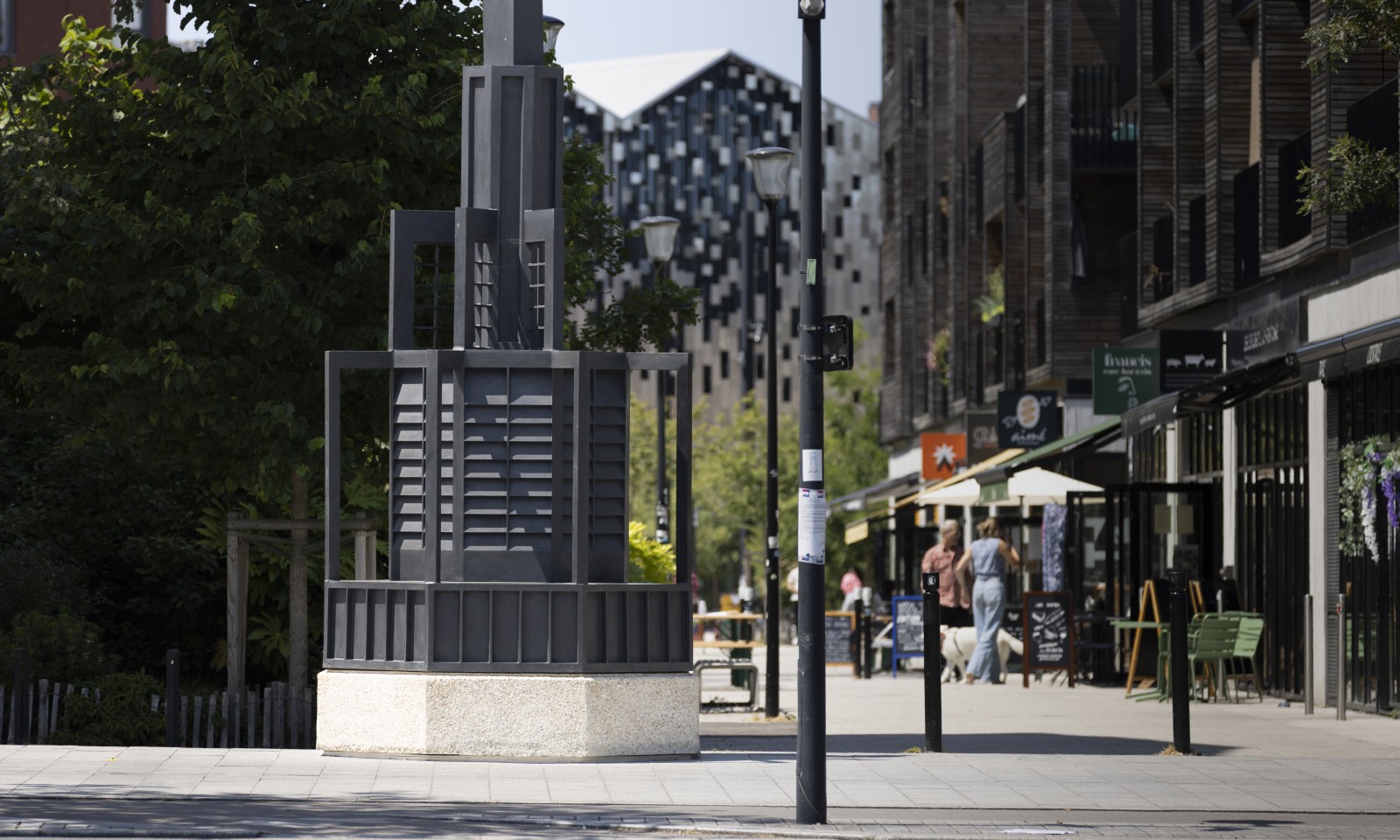
Step 2 : Coupes
Echoing the colours displayed on the station’s glass windows, the sculpture depicts the spire of Saint-Joseph’s Church and perpetuates its memory. Distinct from the building itself, the spire is now closer to visitors, giving them a new perspective on Perret’s architecture.
Step 3 : Pacifique
Amphorae, which were once used to transport goods on ships, are the predecessors of containers. Here, they are stacked to form a column and are part of the port scenery in the Eure district.
-Mickael-Liblin.jpg)
Step 4 : Niki
This sculpture is an enhancement of a limestone rock. Its shape gives the imagination free rein, while also evoking the winged goddess Nike, or even the Nanas of Niki de Saint Phalle. Its position at the entrance to the university makes it both an accessible and symbolic figure.
-Laurent-Lachevre-(1).jpg)
Step 5 : Parabole
In the hills above Le Havre, where the sounds of the city can be heard in the distance, a giant satellite dish encourages you to gaze out towards the horizon. Its circular shape encourages connection through conversation, socialising and play.
-min.jpg)
Step 6 : Volubiles pour Aimé
This plant-covered totem is designed to slowly grow over time, forming a vertical jungle. This installation offers plants a space to reclaim and symbolises our desire to reconnect with nature in the city.
-(1).jpg)